


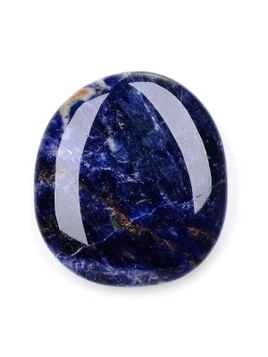
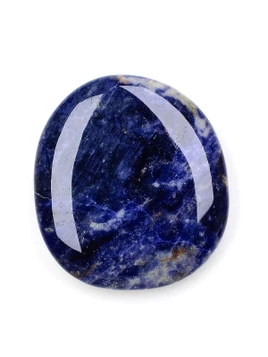
Sodalite Pocket Stone - 19-HAU-16
1.73" X 1.59" X .36"
$18.00
1.73" X 1.59" X .36"
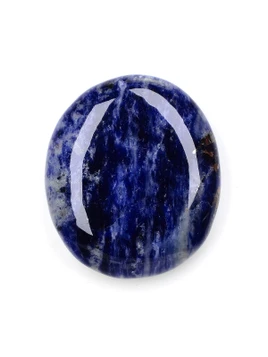

1.74" X 1.44" X .38"


1.64" X 1.64" X .37"


1.65" X 1.47" X .36"
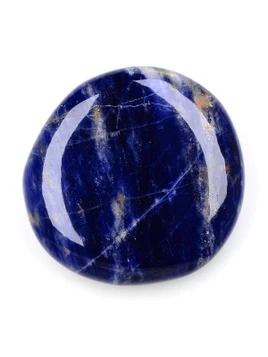
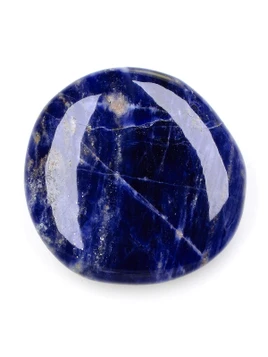
1.80" X 1.73" X .42"

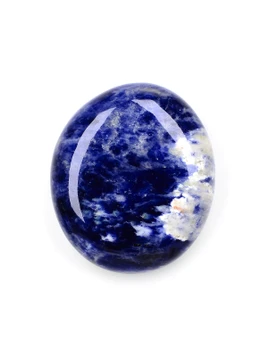
1.53" X 1.32" X .45"

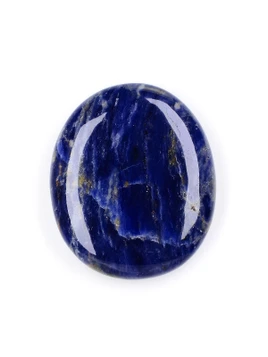
1.67" X 1.40" X .40"


1.5"

.80" X .60"


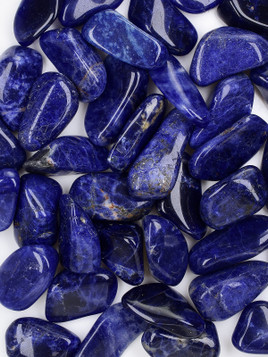

Sodalite was first described in 1811 from specimens found in Greenland's Ilimaussaq complex. Its name comes from its high sodium content, combining "soda" with the Greek lithos, meaning stone. The ancient Caral civilization of Peru used Sodalite and traded it widely, and Bolivian deposits supplied artisans in the Andes. In 1891, significant deposits were discovered near Bancroft, Ontario. Following a visit by Princess Patricia of Connaught in 1901, Sodalite was used to decorate Marlborough House in London, which led to it being called "Princess Blue."
Sodalite ranges in color from royal blue to violet-blue, often with white calcite veins running through it. It belongs to the feldspathoid group and is a sodium aluminum silicate chloride, Na₈(Al₆Si₆O₂₄)Cl₂, that crystallizes in the cubic system. It has a vitreous to greasy luster and a Mohs hardness of 5.5 to 6. Many specimens fluoresce orange under UV light, and the variety hackmanite is photochromic, meaning it changes color with light exposure. Sodalite forms in silica-poor igneous rocks such as nepheline syenite. Major sources include Canada, Brazil, Bolivia, Namibia, Russia, and the United States.
Sodalite is associated with truth, clarity, and communication. It is linked to the third eye chakra and is said to calm the mind, strengthen intuition, and support inner reflection. It is commonly used in meditation, placed in workspaces to aid focus, or carried for emotional balance and honest self-expression.